Showing posts with label Katleah. Show all posts

Thursday, February 3, 2011

Happy Birthday, Tomas!

Happy Birthday, Tomas!*

Made in commemoration of the 400 years of the University of Santo Tomas, Manila
via the "Varsitarian"

By Lourd Ernest C. De Veyra


What birthday? Birthdays are for six-year-olds whose parents feel a happy obligation to bring sweet spaghetti and ice cream to the whole class. The 400th birthday is a lame phrase. The number beams with tectonic magnificence, conjuring images of monumental cliffs, mountain peaks vanishing in feathery clouds, the sun, the slow-dance to the rhythms of the geological clock. “Birthday” smacks of silly party hats and parlor games.

We never use “birthday” when referring to manifestations of nature’s might. The Rock of Gibraltar, the cliffs of Dover, the Arctic glaciers. For me, it is much easier to imagine the sounds and smells of the Pleistocene era than to imagine UST being born, being constructed. Don’t ask me why. Perhaps it is because the university feels older than the earth itself—even with the presence of a McDonald’s and a KFC. There’s just something in the air, the trees, the bricks, even if the brick had been laid just last week. For me, the university has been there for as long as the stars and the sky have been there. For grace unending is grace without beginning.Of course, I am aware that behind each stone, each brick, each nail—ancient or otherwise—lies the mark of human toil. But like Beethoven’s fifth and ninth symphonies, the “Toccata” of J.S. Bach, Picasso’s “Guernica,” the Sistine Chapel, Citizen Kane, Joyce’s Ulysses, the Beach Boys’ “Pet Sounds,” the Christo Redentor in Brazil, the Great Wall of China, Machu Pichu, the Taj Mahal,Michael Jordan’s final jumpshot against Utah, these go beyond human provenance and enters the realm of the divine.

Divine, yes, even if sometimes we see the occasional teen idols from ASAP dancing here every now and then. Even if a lot of students taking on the choreography of noontime-show harlots replete with thumping pelvises and jiggling mammaries. Even if it has charlatans and traitors equaling the number of heroes and geniuses on its list of alumni. The University transcends all these, just as the earth is beyond the middling and the trifle. But then again, I understand the value of commemoration and history, so by all means, uncork the champagne, roll out the red carpet, launch the fireworks, ribbon-cut the exhibits, gather the intellectuals for the endless string of symposia, unveil the new, expensive pieces of sculpture. But a force of nature, both human and celestial, like the school deserves a much more solemn, more pagan celebration, like worshipping stones, chanting, ritual sacrifice on the football field—oh, wait. Sorry. This is a Catholic institution.

The University has been there for 400 years and will be there for another 400—assuming that the ancient Mayan astrologers are wrong about the world ending in 2012.

So stop this “birthday-birthday” business already. The word does not do justice to the sheer grandeur of the number. So pardon, if you will, this absence of sentimentality and gushing expressions of cheer and felicitation. You’re 400 years old. You’re a big boy now.

* Url:http://www.varsitarian.net/literary/20110126/happy_birthday_tomas

Getting inspired by the Thomasian grandeur and Katleah..

Getting inspired by the Thomasian grandeur and Katleah...

Regarding the writer's visit to the University of Santo Tomas
in its commemoration of 400 years, and the drawing of Katleah, this time as a Crusader


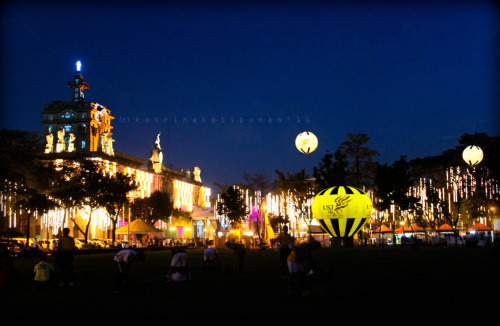
I was quite amazed by the majestic appearance laid by the University of Santo Tomas community in their 400th year celebration last January. And as I looked upon it, it was Espana y Pilipina rolled into one as most of its audience, the students, friars and members of the entire community, paid respects to their patron saint, as well as the Spanish Dominican founders, and famous ex-alumnos who made USTe feel to its peoples "an unending grace."

And as I enter its premises, I personally again think about a maiden named Katleah.

I don't know why upon entering the Espana campus lies recalling her appearance-from the brown to gold hairstyle, Sino-Hispanic like features, well-good body built and semi-boyish attitude (based on my description), Katleah again once more became an object of artworks-perhaps because of getting inspired by the events happened in USTe.

And that time, acting as a "Crusader" in my set drawings, whether with her sword raised or with the retinue of Friars garb in old Dominican habits and laymen in Mediaeval garb, Katleah is described most as "deviant" to the typical female of the age old times-like those of Jeanne d'Arc and Queen Elizabeth I of England. For information, these personalities also served as an inspiration for my artwork, in creating Katleah as a warrior maiden (that started years ago).

And personally to say that because of the events happened, first after seeing them via the window of bus and on the last day, going directly to meet my colleagues; even reading one of their coffee table books describing UST's history and the like, or even my ancestor's pictures and anecdotes (I am not a Thomasian so to speak, but I pay tribute to my ancestors although I defied their suggestion to study there), served as a factor in creating Katleah-this time under the Auspices of the Black and White, yet remained Red and defiant against the rotten order (like those from ACT NOW!).


Well...
Perhaps I was being compelled by the surroundings to draw that's why. And once even compared Benavides's statue with those of Lenin's, and on one article made by L. M. Guererro about the Quattromondial to the one based from the Soviet Union!

Rose Vignette-1875-1909

The Rose vignette, used by the institution till 1909 even reminds of tattoos since Roses are sometimes being drawn on the back or on the chest, as well as the band "Guns and Roses" whose logo includes red roses as its design. To tell frankly, too "Gothic" so to say. Same as the coat of arms one I recognized before the current one, that seemed to be "suitable" as a "greater coat of arms" while the current one as the lesser.

And cut the long story short, the grandeur of what is, Thomasian, left profound memories of experiencing the nostalgia being shared to its legions, being imbued with unending grace.

Monday, January 3, 2011

Tuesday, December 28, 2010

Examples of Music being played in Radio Bandiera Nera

Examples of Music being played in Radio Bandiera Nera


It all started last last year, when I listened to the radio known for its European music, that in fact caters to the far-right. That radio, named "Radio Bandiera Nera" is trying to be the online countercultural radio being brodcasted much via the internet.

But then,
I myself notice much that despite its far-right tone, of promoting Casa Pound and other Far-Right organizations, especially in Italy, the music being played much is somewhat more into avant garde, industrial, to oi! and metal of all kinds. While I, a left-winger, listened much to it not caring its right-wing sentiment being promoted by that online radio.

Secondly, I myself is an avid listener of those music, and at least it offers somewhat an alternative to the mainstream music usually played in the Radio, or shown in MTV featuring nonsense music (except to those unforgettable, good to listen ones of course) that makes a person suffered by a symptom named "Last Song Syndrome."

And the songs like "Nur Ihr Allein", "Alexanderplatz", and "Friday im in Love" are unforgettable to listen-especially the latter that once I heard it when I was young; while song Alexanderplatz even reminds of writing a story I usually do so. Same as the song made by In Extremo that intensifies my interest in my subgenre.


After all,
As according to the first writeup that introduced the online radio station, it said:

"As I listened to the music played in RBI, devoid of their message of "white power", "anti-socialism", somehow it also mirrors the fact that the system rotten and its people desired a need for change. Whether it is "the Cure" or any other kind, even Musikangbayan and the ones who sung "Awit ng Rebolusyonaryo" (Song of the Revolutionary), they wanted change in all sorts-including love and relationships..."

Saturday, December 25, 2010

Nur Ihr Allein by In Extremo

Nur Ihr Allein by In Extremo


German Lyrics

Hinter mir könnt ihr sie sehen
Die Strolche lernen aufrecht stehen
Auf unserer Vagabundenreise
Da regeln wir's auf unsere Weise
Wir prassen bis die Nacht zeronnen
Bis Blut und kleine Knochen kommen
Danach in dunklen Ecken weilen
Und wie die Diebe Beute teilen

Refrain:
Ihr nur ihr allein
Konnt ein Teil des Ganzen sein
Ihr könnt vor eurem Leben fliehen
Oder mit uns um die Hauser ziehen
Ihr nur ihr allein
Konnt ein Teil des Ganzen sein
Aus diesem Grund sind wir erschienen
Wir sind verehrt und angespien :

Herausgeputzt an hohen Tafeln
Hört man uns vom Reichtum schwafeln
Zu dienen ist uns eine Qual
Ein Strick am Hals der kratzt nun mal
Und dafur hassen uns die Neider
Doch nachts da klau'n wir ihre Weiber
Wir machen's wie die Sonnenuhr
Wir zahlen die heiteren Stunden nur

refrain

Zarte Liebe ist uns heilig
Doch wir haben's meistens eilig
Denn wer nicht kommt zur rechten Zeit
Der muss sehen was ubrig bleibt

refrain

Auferstanden aus Ruinen
Werden wir verehrt und angespien

Refrain


Roughly translated English version

Behind me you can see it
The thugs learn to stand upright
On our trip vagabonds
As we sort things out on our way
We can splurge zero until the night
come up small blood and bone
After that dwell in dark corners
And how to share the loot

Refrain:
You Only You
Could be a part of the whole
You can escape from your life
Or go with us to the houses
Your only their own
Could be a part of the whole
For this reason, we have appeared
We are honored and spat:

Dressed up in high panels
If you listen to us chat over the wealth
To serve us is a pain
A rope around the neck of time scraped now
Darfur and the envious hate us
But at night because we klau'n their wives
We make it like the sundial
We pay the happy hours just

repeat refrain

Tender love is sacred to us
But let's have mostly affected
For those who do not come at the right time
What remains of the need to see what

repeat refrain

Risen from the Ruins
Will we worship and spat upon

repeat refrain

Monday, December 13, 2010

On linage, origin, and remolding

On linage, origin, and remolding


Yesterday, while riding in a bus, I was thinking about on how an individual, regardless of its class background, is willing to become a part of the revolution. At first, I think about it as difficult and even contradicting since how come a person coming from a privileged background be remold from the series of realities, education, and becoming a part of an idea-outlook that is, contradicting to their class or gentry?

Well...
It even reminds of Yu Luoke, who, in his writeup entitled "On family origin", counters the system's couplet "If the father is a hero, then a son is a good guy; if a father is a reactionary, then a son is a rotten egg", calling it as an error as he said:
"Its error consists in holding that family influence exceeds social influence and in failing to perceive the decisiveness of social influence." Or rather say that "He/she puts the influence of his/her family over social influences."
But then, through practise, reveals the opposite conclusion that:
"The influences of the society far exceed those of the family: family influences are subordinated to social influences."

Yes, but how?
The media, the social realities around us further develops the individual greater than the family, friends and relatives even transcend the limits of a 'family-focused' influence towards an individual. Engels, for example, despite his privileged backgrounds became a well-renowned Marxist due to his work in the factory, and that includes mingling with the workers and knowing its conditions around it; the suasion of reading materials, radio and television; the influence of customs and subcultures that affects much of an individual. An indelible influence so to speak, that is different from what the others tend to think as "biological", such as the "blood lineage theory" and other related ideas.

As of this century, wherein anything is mass produced and most of it carries lack of quality, it also affects the culture of humanity since anything around us encourage to be totally materialistic-buying anything regardless of its defect, or simply because of the trend prevailing, or being dictated much by the prevailing social order. The Jejemons for example, are individuals affected by both mainstream hiphop and cellphone culture, and thus its appearance and on how he/she send its messages. That culture became widespread regardless of social status as the society around prevails this kind of trend, or in case of Yu Luoke-it transcend or break family-centric norms and cultures.

So is in creating revolutionaries out of individuals regardless of class or blood lineage. If they insist much on blood lineage then how come Lenin, despite being a Russian Marxist came from a minor noble family? Of Mao, from a rich peasant background, same as Zhou Enlai? There was another couplet told by Jiang Qing, and said:
"If the parents are reactionaries, then the children should rebel..."

Speaking of Jejemons anyway, like any other cultures that being tolerated by the order, of making it as a fad, it seems that they compelled the youth, or the people in general to be a part of it, and personally to say, how come the order tolerates those kind of mess, of degenerating one's individual into a pile of trash while assailing those who are trying to break the norms in the name of righteousness? Indeed, they are scared of the absolute norm telling to the world that "it is right to rebel", of what Jiang Qing said to the people-especially in times like these that most people are becoming nothing but eaten by the social cannibals and of the "flow" they've been forced to join.

I somewhat agree with that statement made by Jiang Qing, stating that "the children should rebel" since to an individual, he/she tends to break the cycle of what the family prevails-by all means necessary to show who he/she is. And society, especially the realities around and the culture, counterculture tends for that individual to "rebel" against the flow regardless of the person(s) affected. These are based from what comes from outside, not biological, internal as those who said "innate red" in the Blood lineage theory. The surroundings around, especially in a Capitalist society, tends to create both "positive" and "negative" interpretations of life; as the former spoke of modern things and privileges, the latter spoke of poverty and yearness for socio-economic and political rights.

But then, as the system tolerates much of its negative tendencies, of continuous trend of corrupting mindsets really creates "rotten eggs" as people in general, possibly confirming that if the sons of the reactionaries copy those of their forebears is indeed, a rotten egg in nature-regardless of its surroundings as well as apathetical in realities due to its ultramaterialistic tendencies and less emphasis on what's going around the entire rotten community; it may continue generation after generation if the order tolerates it, making humanity itself never be liberated.

After all, regardless of origins lies the right to choose its own destiny. But what kind of destiny humanity ought to be then? Will that individual choose to be a rotten egg or a righteous? To be contented or to be progressive? To the rich, it may sound contradicting since they think that anything comes from their lineage-as the blood lineage theory says so, and possibly thinking that their children's fate is determined by blood, from their mother's womb, alongside wealth and fame. But how come Marx, Engels became closer to the "have nots" yet they belonged to a gentry? Yes, as "Man can choose the direction of his progress. This is because the truth is stronger and has a more compelling power," But to a society that is rotten, will these words really speak for itself? Or just a figment of an imagination-as the entire mass of humanity are being forced to join the flow and become cannibals, if not, slaves. Yu Luoke spoke of the community as a contributing factor, but the negative effects, like the family's may further corrupt a certain individual, unconsciously becoming a rotten egg-as the innocents are becoming victims of the "flow" courtesy of the system-sponsored culture prevailing in the community.

As a writer, I don't speak for Yu Luoke, but rather I found his idea a but informative about the individual, on how the surroundings, including his/her family affects his/her consciousness. And in regards to culture, it may find it applicable since the society, a capitalist one, or rather say a semifeudal-semicolonial type, the idea regarding the possibility of transcending the society's norms and acquire proletarian consciousness would pave its way to a means for reforming one's individual, remold regardless of its origins and rectify its own errors in order not to become "rotten eggs".
Monday, November 22, 2010

New European Fashion

New European Fashion*

by Constantin von Hoffmeister


New European fashion has to be strict. It has to be fashionably strict. Cut along the lines of imperial traditions (dating back to Ancient Rome), it has to exemplify the uniformity of the nation's iron will. Cut along the lines of individualist traditions (dating back to Thomas Jefferson and the Great White American Republic), it has to exemplify the will of the wearer that serves the nation with pride and individual distinction. The wearer and the uniform - one for all and a symbol for the New Glory. The young people of the Empire disregard the bourgeois fashion mentality of the old people of the corrupt republic. The young people of the Empire look to the stars for inspiration, they look to the men who conquer planets for the glory of the Empire for inspiration.

New European fashion has to be instantly recognizable as something new. Transcending the past and bridging the present with the future, it nevertheless must firmly anchor itself in the long line of European fashion traditions that preceded it, all the way down to the punk and androgynous beatnik look and the hip (but strict) armies of Queen Victoria. Archeo-futurist, retro-modern

and fashion for war
war in peace
style in war
style in peace
ready for war

battalions buttoned up
lines leading straight
(loose for losers)
form-fitting
finalizes freedom

Johnny Rotten marries Gabriele d'Annunzio: the complete synthesis of complete freedom and utter disregard for the values of the herd and the morality of the masticating masses is blended with the acceptance of lust and power as the twin principles of the New Dawn. The road to the New European Renaissance leads across the shattered bones and discarded corpses of fashion victims of yore (when the lands yielded nothing but media death and despair in blue jeans). The slogan "Black is beautiful" is reclaiming its rightful place as a slogan that applies to Occidental fashion - no more negroid servitude, but with heads held high the new young Europeans will march down the roads of reclaimed cities and landscapes clad in the color that defies all colors, brandishing the black flag that will supplant the rainbow flags that have poisoned us all.

Marching across fields and across rivers and across the dead armies of the enemy, the new young Europeans in their boots and black uniforms and bright outlook see ahead the road that will lead them to freedom filled with lust and romance and danger (three key ingredients in the young men's and women's cocktail - served in the bars of life). Across the Empire on avenues newly lined with freshly planted oak trees, the new young European men walk hand in hand with the new young European women, the men's uniforms sleek and form-fitting and the women's black leather knee boots dominating the asphalt, quivering under the might of the new model army. And across the faces of the happy couples smiles of joy and victory, above their heads not a single cloud and the birds of steel whirring overhead, leaving smoke trails and sounds of thunder - the might and fury of Wotan has returned, in his eye reflected the anger and passion of his new young disciples, ready to love and die and love some more the day that has dawned and die again the only death worth dying: the death that promises life. Love and passion and the fruit of their loins ensure victory over death - the mighty Race lives on through countless future aeons when young couples see the endless vistas of space in the eyes of their lovers and know that procreative sex killed death! One are the many because the Race is one!

When the Race goes shopping, it goes shopping for war, conquest, love and passion! The bearers of the Race's pride, the Race's honor, the Race's ensured existence for millennia, eternity and always - these bearers wear what the fashion of life and death dictates they must wear: The black badge and the black collar and the silver emblem proclaiming their value as the eternally young warriors for freedom and joy, for liberation and destruction, the old for the new, the canvas for the slacks - streamlined and woven into perfection, the young warriors chewing the joy of having vanquished the enemy easily stride side by side along the wide boulevards: a victory parade in blue, black and purple! The colors of European joy, nobility and fraternity, arm in arm, locked in step, marching, dancing, the streets vibrating with the joy of blood spilled for THE BLOOD! and endless columns of spectators showering this young army of new model men with flowers, ribbons and music that will reverberate through the ages the eternal song of an eternal continent, an eternal planet, an eternal galaxy: WE SEE! WE WILL! WE TAKE!

And we have seen the pain of men without women, we have seen the pain of women without guidance, we have seen the pain of couples not coupled but lost in an atomized multitude of their own people, their own race. The future holds what is dear to all, the future promises what all young desire, what all young need, what all young deserve! The truth in copulation with your own spells the only truth of procreation: the eternal joy of the eternal chain, linking forever the old with the new, the ancient with the modern, the archaic with the futuristic - the line that binds is the line that holds, unbroken from solar system to solar system, from planet to planet, one end holding the other end, arms outstretched, light years and aeons apart, but always knowing the true source of bliss and power and ultimate desire: unity within and unity without, the Race one like the naked Greeks wrestling amongst themselves. The Greeks were naked, so we shall be naked! We shall be naked with pride and we shall be naked with the pride of men and women who willingly enter each other to produce and perfect the offspring that will in turn give joy to each other and thus perfect and hone and tune values inherent in both body and spirit.

The period is the belt buckle and the exclamation marks are the suspenders. Where is the working class? Where is the goal that promiseth everlasting glory? Rimbaud the Frenchman has seen, Hitler the German has seen and Churchill the Englishman has also seen. What do we see? What do WE YOUNG PEOPLE see? We see what is OURS and we see what is NOT THEIRS. THEY MUST GO SO WE CAN LIVE! Their rags against our suits, their Haj caps against our proud hats, their pride in a lie against our pride in the real. The equation is nil. The question is answered. The answers are open. Our suits can be soiled but THEIR HEADS shall roll!


* Url:http://www.kolumbus.fi/aquilon/journal/09e.html

Thursday, November 4, 2010

Thank you NU!

Thank you NU!

by Renato Reyes Jr.


From one who was part of the post-XB generation

For your test broadcast in 1987 that opened the eyes of a kid just out of grade school
(Even though late, we thought New Wave was cool)
For The Bolshoi and X-mal Deutschland,
Gene Loves Jezebel and The Smiths
For the Clash, The Ramones and the Sex Pistols
And the White Wedding of Billy Idol
For the 10,000 Maniacs and Midnight Oil
For U2, The The and REM

For the early mornings you’d play the WUDS’ “Teachers and Cheaters”
For Till Tuesday, Sheryl Crow and the Pretenders
For Gin Blossoms and Weezer
Belly and The Beeders

For the Eraserheads and Yano
The occasional Ethnic Faces and Binky Lampano
For Rizal Underground and Color it Red
For the Breed’s Black Mercedes Benz
Can we forget Remote Control Weekends?

For Trop Dep and Coco Jam
For Datu’s Tribe, Razorback and Wolfgang
Sugar Hiccup and Urban Dub
Slapshock, Queso and Greyhoundz

For G n’R, Aerosmith and Poison
And all those glam/metal bands that abused hairspray
For Pearl Jam, Soundgarden, and Nirvana
and the Red Hot Chili Peppers and Green Day

For the Rock Awards that saw The Jerks win Album of the Year

For Metallica and Rage Against the Machine
And the awesome guitarists of Mr. Big and Extreme
For rock jocks that made mornings interesting
For opening your airwaves during EDSA 2 uprising

For not spreading hate by bashing hip-hop
And those who still enjoyed pop
For Two Girls in one show
And for the pioneering In the Raw
And Rock ED radio

And though we haven’t been close lately
I will fondly remember you for being part of my musical education and growth
As you sign off, with some of us still in shock
You will be always be remembered as
The Home of Nu Rock


Renato Reyes Jr. Also known as "Nato", is the spokesperson of Bagong Alyansang Makabayan. He's also an avid listener of NU 107.

Wednesday, November 3, 2010

The blossoms of revolutionary struggle

The blossoms of revolutionary struggle

People's art and literature bloom out of the Filipinos' real daily life and experiences

by Marte Mirador

Liberation, August 1984


Photobucket


There are two main currents of art and literature existing side by side in a subdeveloped country like the Philippines. One results from the creative activity of artists and writers who cater to the "highbrow" aesthetics and "refined" sensibilities of the elite. The other is the product of artists and writers who identify themselves with, or who themselves sprung from the huge majority of Filipinos whose social, economic, political and cultural advancement they champion through their works.


Photobucket

Photobucket


Such dichotomy may hold true for the rest of the Third World, where gradations and extremes of opulence and poverty define the socio-economic spectrum and dramatize the daily human condition. In such a society, it is not unusual for one breed of artists and writers to strive for "universality" in an attempt to break out of or "transcend" harsh social realities by harping on "eternal verities" like "the true, good and beautiful," in the process abstracting themselves out of the overwhelming social context. This breed of artists and writers is often rewarded handsomely, if not through state recognition and sponsorship then through private patronage, a la Medici or Marcos (though the latter cheats by stealing awesomely from the people and giving to the famous and great what is passed off as royal largesse). Many times, such artists and writers dutifully reciprocate the favor by acting as purveyors of court art and literature, and as witting or unwitting glorifiers of the authoritarian regime.


Photobucket

Photobucket


On the other hand, there is the growing circle of artists and writers who pour out their creative energies into the crucible of struggle, forging weapons of criticism through art and literary works by which they would lay bare the social ills of their time, even playing the historian's role by tracing the root causes of social, economic and moral malaise through the ages, exposing the canker gnawing at the system - the malady common to Third World societies with a common legacy of colonial enslavement and neocolonial plunder.

We may call the first current as establishment art and literature, the second as people's art and literature. By establishment, we mean those that are not only being funded and financed by the state for cosmetic purposes, but also those that are being upheld, patronized or financed by the profligate elite. Creative works emanating from this culture-of-the-status-quo claim to be devoid of or "free from" any ideological content, are simply manifestations of individual genius and the bourgeois "Muse". Thus, in such art, we have various degrees of abstract expressionism, unintelligible to the "uninitiated" masses. Thus, in such literature, we have fiction and poetry and theater which hew closely to the bourgeois, intellectualist tradition (or belle lettre-ism) bereft of indigenous, nationalist, historical moorings. In a word, an art and literature of alienatedness.


People's art and literature include all creative works (painting, graphics, murals, sculptures, poems, stories, plays, films) that draw substance and content (and to a great extent, even their formal structures) from the people's traditional culture as well as from the all too real daily struggle for life of millions of Filipinos: peasants and plantation workers, factory laborers and peons, fishermen, miners, urban poor and dispossessed rural folk, oppressed women and neglected children, and many others. The central theme of people's art and literature is the struggle of these people against the evils spawned by the enduring legacy of centuries of colonial rule, expressed in the present complex of neocolonial realities such as feudal oppression, political tyranny, economic exploitation and military terrorism.

The primary goal of this art and this literature is the creation of a truly national and democratic culture that embodies the free spirit of inquiry, the freedom of creative expression built around the experiences of the great majority of the Filipino people. Unlike the individualist bourgeois concept of artistic freedom, however, this new spirit does not exist apart from the full sense of community and collective interest that, in ages past, characterized the life and livelihood and the arts of the people - a state of society long since subverted by modern relations of exploitation and domination characteristic of class society and the global capitalist ethic.

Where do we find people's art? We find it in the creative works of the revolutionary underground, in the form of artworks such as drawings, illustrations, paintings and cartoons accompanying political commentaries or heroic accounts, or those standing on their own as acerbic comments on the status quo. We also find it in the creative works existing in the open, in the country's urban centers, where art exhibits and art circles proliferate and where a significant group of socially conscious artists is crafting the first noteworthy generation of social realist art and revolutionary expressionism and symbolism. One of these artists once remarked that social realism may not always describe what they are doing, but that social criticism or, simply, revolutionary art, would. Bourgeois critics would dismiss socially critical art as so much "propaganda". Precisely: all art properly belongs to the great battlefield of culture, of ideas, of man's future, and this clash between theories of art and world views is to be expected.

Where do we find people's literature? We find it, likewise, in the revolutionary underground, in the form of poems written by guerrillas and workers and peasants and cultural workers from the petty bourgeoisie. A recent development is the rich harvest of countryside literature from those who, apparently, have succeeded in unleashing the creative spirit possessed by even "the simplest man". But there is, of course, no such thing as "simple man" (said of workers and peasants, for instance, who are expected to be capable only of manual toil and material production); there are only undeveloped potentialities, untapped human genius, trapped inside the "simple man" by the conditions of human labor and the restrictions of the system. People's literature is very evident in anti-landlord plays, written, scored, choreographed, produced, directed and acted in, collectively, by revolutionary cultural groups in the countryside, in which the peasants are not merely spectators but can become part of the performance. It is also found "above ground", as practiced by poets, fictionists, essayists, playwrights who, though they write from urban centers and university campuses and who may yet have to fully immerse themselves in the proletarian and peasant milieu they write about, express the profoundest solidarity with the majority of the Filipino people. They refuse to go the way of elitist writing and, worse, pro-regime bootlicking, as is the case with some well-known, much-awarded former progressive writers who have managed a foothold at the fringes of the dictatorship, from where they snatch with eager jaws the meaty bones and tasteful carcasses the Queen of Tarts may strew their way.

While people's art and literature by themselves cannot launch a social revolution for national liberation, they nevertheless are volatile, potent propellants which can fire up the hearts and minds of an entire people, motivating and strengthening them in their momentous march towards a better, more human and humane future.

Saturday, March 27, 2010

A letter to Katleah

A letter to Katleah


Dear Katleah, or rather say "comrade,"

Its so happy to see and hear that you finished college. Happy because you finished four years of mind and body twisting ordeals that seemed make you "nose bleed", "groggy" and anything that may never control most of the time.

But then,
Despite all of these things you have done with, lies sadness as you finish college and leaving it full of memories both material and immaterial. In fact, as I notice you during the first days of meeting, of running as a candidate in the CAS student council, under the banner of KBPA last 2008, I was nearly inspired-from listening to you singing "rosas ng digma" (a tagalog song meaning "rose of war") with Troy while playing a guitar, of enjoying with some friends' company, that even made me compelled much in drawing every features of you, and end up you (in my works) clenching a fist, carrying a gun, or even donning a "Liza Maza" getup of white and having a pink scarf. Well... perhaps out of activism rather and of you, creating a being whose beauty and strength is a product of ceaseless admiration.

And despite all the tragedies I passed though, of having a fight with your friend, I never made wrong or anything against you. But on the other hand, out of that "away", I became so shy, whenever I wanted to meet and have a chitchat with you. True and weird isn't it? But then, Despite any attempt to meet and having a chitchat, perhaps no to avail, since both of us are having most of the time working. And secondly I consider it "difficult", wanting no fight therefore better not to speak though-and instead preferring other means like drawing, of girl with a gun, rising a left fist, having a red star, wearing a mao cap or budenovka headgear, carrying an AK47, etc. Making the person who created is a hardcore.

And like the the song "Comrade Lover", with no regrets in doing every work both school and in struggle, that I sacrificed the blood, sweat and tears of my youth to complete every ordeal-all of these are due to you as my inspiration, as you sing every pop song whilst I listen to hardcore speeches.
As what the song said:
"Joy and Sorrow,
parting and union

-The story always the the same

Hand in hand,
and unchanging face"


Perhaps, it's (or all it's) over, since you are leaving UE with profound memories. And so are the works full of agitation. "All hail thou hope of our land, Loyal thy sons we'll ever be."* these are the words I may say to you my once inspiration and idea in my work. Or rather say, we have another battle to face!


Farewell to a red star shining! You may have left UE, but there are millions of Katleahs, red stars rising and shining in the realm of struggle! HASTA LA VICTORIA SIEMPRE!

From a comrade, and once a friend
Paul

*From Teogenes Velez's "UP Beloved" (UP naming mahal)


Tuesday, January 5, 2010

KATLEAH: A GOOD INSPIRATION FOR (ART)WORK


KATLEAH: A GOOD INSPIRATION FOR (ART)WORK


It was all started when I was looking for a good inspiration for some artworks to be drawn, looking until I sought a girl whose looks seemed good, more of a proletarian kind-a lively face, of a pleasing but strong willed personality, and a good built that seemingly reminds of a female Kolkhoz farmer working for hours tilling the soil; and thus that girl became a good basis for "revolutionary artworks" featuring women.


But then,
That girl, whose name is Katleah, perhaps unknowingly didn't think it badly regarding this kind of thing being done, or being made through a series of drawings and perhaps even some stories whose female protagonist and its image can be based on her, well... for me she knew that I am drawing and even recognizing my talent, although on the other side it can be considered as annoying-especially in getting "drawn" and end up in a piece of paper featuring a girl wearing a gimsterka, pants, boots, a budenovka as her headgear and carrying an AK47 or some sort-for based on what I have seen for her, more of "that", a Kolkhoz woman, a proletarian, a revolutionary-anything, left, radical especially for that girl.


And in addition to that,
I am deeply influenced by the left through a series of books (like the communist manifesto, the French revolution, Les Miserables) and other writeups since childhood, somehow drawing or writing stories anything based on Katleah or even other ones also expresses more of personifying the struggle, like Berglend back then whom I drawn her as a female knight or Charmel as a beautiful empress with a humble heart, Katleah somehow to me is the struggle as a woman, a maiden whose prowess in the protest-battlefield is her outmost devotion to the people, including the acceptance of death..

Anyway,
Katleah is struggle, like Lorena she is the woman who gives anything to the people.

Sunday, December 20, 2009

KATLEAH: DRAWINGS OF PUNK ROCK, METAL AND REVOLUTION


Katleah singing "Der Offene Aufmarsch" in a picketline-concert


Katleah Raising a toy AK-47 while singing a punk song in a picketline-concert


KATLEAH: DRAWINGS OF PUNK ROCK, METAL AND REVOLUTION

Monday, December 7, 2009

Saturday, October 17, 2009